“It’s not what you look at that matters, it’s what you see.”
― Henry David Thoreau

“Wow – your colors are so different from mine!” she said.
My first thought was “What are you talking about?” My thoughts then quickly went to “We are looking at the exact same spreadsheet – Shared file and I was sharing my screen so we were seeing the same thing in real-time. The excel file only has one palette of colors, she is clearly selecting a different color tile than I am. The wrong color. She’s wrong … I’m right”
I was sharing my screen with a teammate when we began to color code an excel sheet to keep track of the decisions we made as we reviewed the sheet together. I, not she, was sharing a screen and making the color updates. Ninety miles away, my colleague had the same spreadsheet open on her desktop, yet my colleague kept commenting on how different “my colors” were.
She was commenting on the differences to the point of distraction for me. It was a solid fact that I was choosing the colors from the palette available in the exact same excel version. So, clearly, my colleague was making a mistake – she was wrong, I was right. Turns out it was her monitor changing the hues she saw. We simply had different lenses on the exact same colors that led us to conclude that they were different. Our experiences were different. Yet – I still concluded that my experience was right and and hers was wrong.
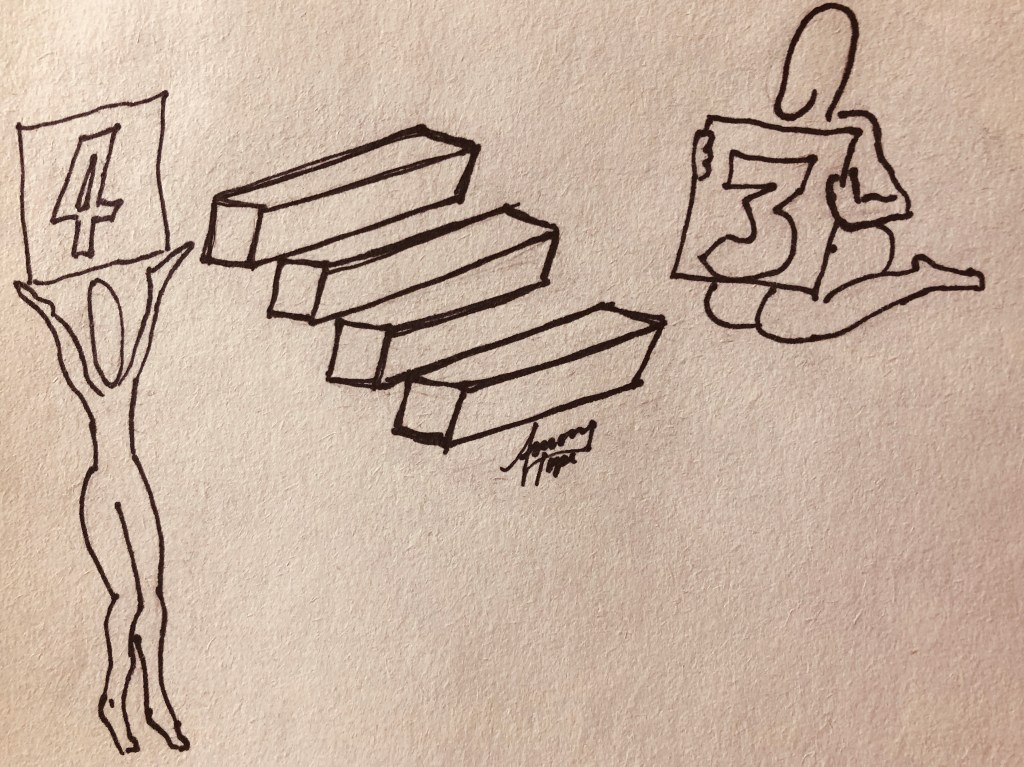
For the better part of my life, I have been confident that there are certain things which are simply indisputable facts … truths, if you will. This premise has guided most of my opinions and actions throughout my life. But how factual are our truths, really? Einstein threw a wrench into the “truths” of physics and time. There was a time when the world was simply flat. It was a fact. Now the world is round; but the world didn’t transform into a globe one day and change our minds. Our experiences simply evolved and became informed by new experiences. How many facts have been proven and disproven as we continue to explore, question, conclude and create more “facts”, which in turn inform other opinions and actions? Too many to count – and really – why bother?
As I get older (and wiser?) and have more experiences, I recognize that while there are facts and truths for each one of us individually, or even within self-selected groups of individuals, there truly is no universal truth. There are no solid facts. There are only observations. We have shared experiences. We have individual experiences. And there are infinite combinations of all these experiences which manifest in each of us. So, “in truth”, what we refer to as facts are simply conclusions we have come to based on our personal observations and experiences.
So what then? When two people come to wildly different conclusions having had the same experience – what then?
Well, it is either tolerance or conflict. Every nation, every tribe, every faith, every committee, every clique, every US Democrat, and every US Republican has selected their truths and their “team” based on conclusions they have drawn from their own personal observations and experiences. Conflict arises when we judge the conclusions drawn by others that do not match our own. More specifically, conflict arises when we allow judgement, our own or our interpretation of others’, to be perceived as threatening.
Within my own family I have seen discussions transition from conversation to debate to tears. What drives us to this level of emotion? In each instance that I have observed it is when some level of threat is introduced. And, by my observation, this threat is most frequently introduced by the perceiver. The threat initially forms internally to the person feeling threatened, through their thoughts and conclusions drawn from what they heard or observed. The genesis (again – in my observation) of the threat is rarely an actual threat.
Most people speak and act with positive intent … at least initially. But when intentions are misunderstood then this triggers a defense response to wrongly interpret motives. Then it devolves from there. Once triggered, there is a reaction, and then another and then another. If you have more than one child, you can probably easily think of a time when the insults flew back and forth like a tennis ball. Getting more and more ludicrous as it continued to gain momentum and build emotion. When this happens it doesn’t generally stop until there is a deliberate act to stop the momentum. Often this is when you, the parent, step in to tell them both to stop being ridiculous and go to their room.
In our house politics can be incredibly divisive. We all watch news about the same events. Well even that statement is slightly inaccurate because we share some viewings but we also each watch, read and listen to self-selected sources which have some bias to their delivery of “the facts”. From this, we all come to wildly varying conclusions.
Let’s use the Cavanugh hearings as an example. Yep – we had different opinions on this topic … I’ll bet as you read this now you are emotionally charged about the fact that there could be a different conclusion on this topic than what you concluded.
So please take this moment … It doesn’t matter what you concluded on this topic. What are you feeling? Why are you feeling it?
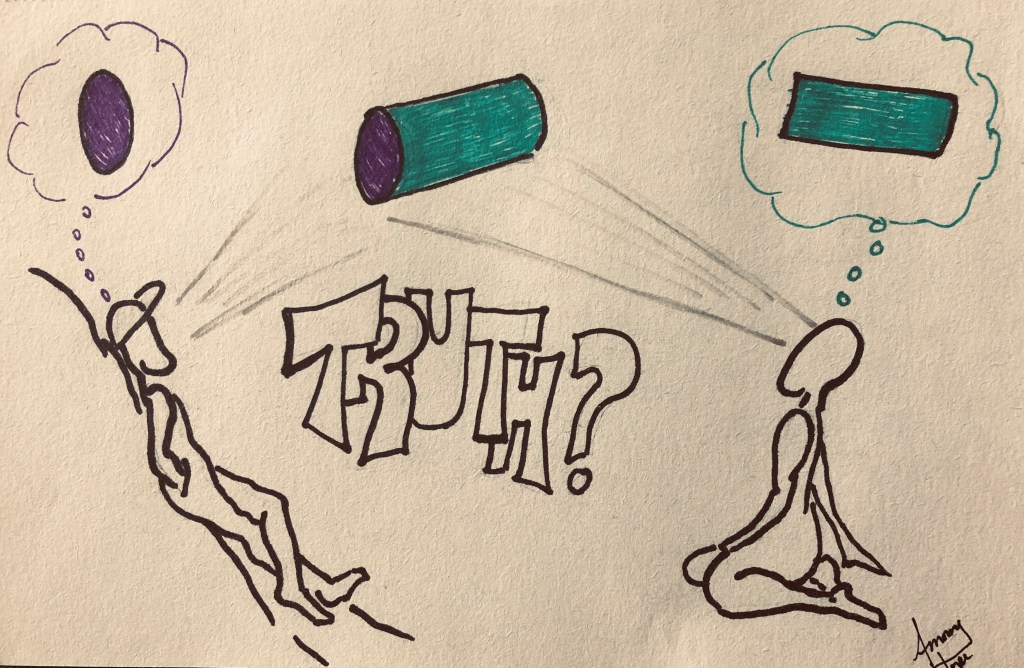
The fact is some people came to different conclusions than you based on the same information. How is this possible? Those who concluded differently than you have heard and seen the same “facts” as you. But you received this information into a mind and being that had quite different experiences resulting in a different conclusion. If you add red to blue it’s purple, add it to yellow and you get orange. You both received red – but the end conclusion was completely different. Does that make the other person a bad person? Nope.
When you think about what you concluded on the Cavanaugh hearings, how do speak of it? Do you refer to it as one possible conclusion based on the limitations of your observations? Or do you say things in more absolute terms; things like “the facts speak clearly!” or “He absolutely … “ or “She absolutely …”
We all tend to hang on to our conclusions as truth or fact. Because of this, each one of us is likely to perceive any challenge to our “truth” as a threat.
What this dynamic did in our family was to take people who genuinely love each other, probably more than any other beings on this earth, to devolve into personal attacks upon each other. The conversation began as a sharing of ideas, which we do quite often. Once it became apparent that two “truths” were evident then each one of the observers and concluders perceived any statements from the other as personal threat. And once this occurred, then each one did, in fact, begin to hurl personal statements until faces were red and tears began to roll. There were no facts – simply observations, informed by individual experiences which led to conclusions which led to judgement toward the ones who concluded differently.
It got so bad that I simply forbade discussion on the topic (stopped the momentum – grabbed the tennis ball mid-volley). From my seat, none of us needed to invite any of these people into our living room at all. None of it mattered in that present moment – in our home – at that precise time. Everyone could, and should, feel free to draw their own conclusions without needing to influence the other to change theirs. This moratorium of debate brought peace. One simple turn away from what was triggering the momentum of discord, defused a highly charged and contentious moment that could have broken a family that loved each other very much. Once the momentum was broken we invested our energy into other unifying topics. Everyone is still fully aware of the conclusions drawn by the other. Everyone continues to believe their own “facts”. But peace has been restored and love continues to heal.
I am not suggesting that you do not honor your conclusions. Nor am I suggesting that you diminish your passion or beliefs. Follow your beliefs passionately – just remove judgement for those who believe differently. Go positively towards something instead of rallying negatively against something.
Some might say that my family did not resolve anything. I would suggest that we resolved the most important things – Love and unity.
I wrote this blog a few weeks before the pandemic was so named. People have been and are continuing to come to many different conclusions throughout the development of our exposure to the Corona virus. There is an abundance of video on social media: in the beginning you could see people clobbering the elderly for toilet paper and others share stories of people delivering tissues to the doorstep of their elderly neighbor. Now we are debating masks or no masks, open or stay closed. Emotions are high as we continue to navigate amid different rules. And I am noticing an intensity of judgement. Each judgmental action is based on how people are defining the truths in their own lives.
How often are your judgments serving a positive outcome?
Take a moment this week, this month or even just today to simply evaluate how much of what you believe to be facts or truths are perhaps more accurately simply personal conclusions. Then take it a step further to observe how many times these conclusions drive judgments that produce anxiety, worry, fear, anger.
How might your “truths” be getting in the way of unity – of love?
What conflict can you avoid by pausing, and simply looking through a different lens?
Take a moment right now – no matter what you are doing (you are reading at your phone or computer after all).
Close your eyes.
Breath in fully through your nose and fill your lungs and belly with air.
Exhale slowly through your mouth.
Now ask yourself,
“What is right in my world today? What is good? What joy have I experienced today?”
Focus your thoughts on that. Let that be your truth.
Then … Let truth be told.
 SevenSenses
Leave a comment